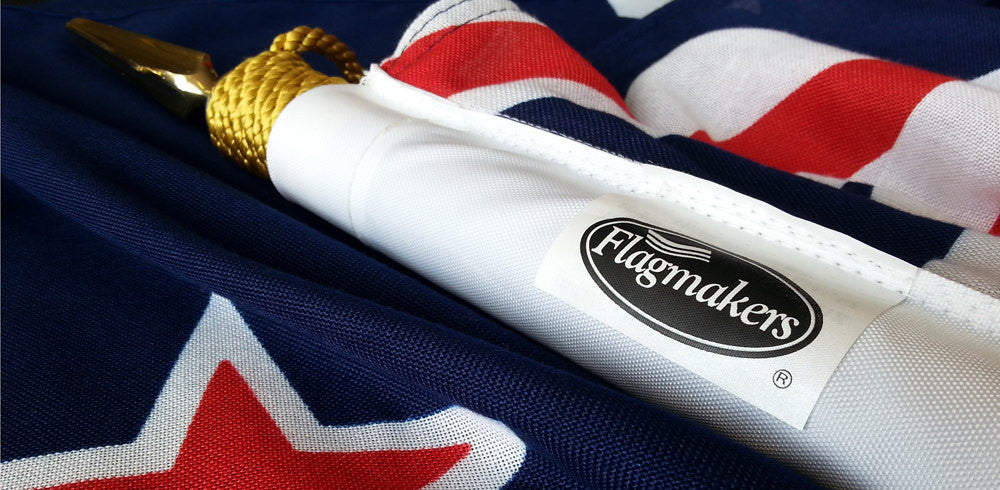
How do I choose the right New Zealand flag?
If you're flying the flag indoors for display only, a standard flag is fine - hang it vertically on a pole sleeved through the header. Most people leave the ropes and swivel clips on so it still looks like an authentic flag.
If you're flying it outdoors in a windy location, choose woven polyester (Polybunting). It needs more wind to fly but holds the traditional look and feel. In calmer conditions, knitted polyester (Polyknit) is lighter and flies more easily in gentle breezes. Both fabrics are equally durable - the difference is weave, not quality.
Look for accurate PMS colours (the flag has official specifications) and solid finishing - most imported flags use thinner fabric and weaker stitching that won't hold up in wind.
You can buy the New Zealand flag from Flagmakers' online store, from the Wellington showroom, or by emailing sales@flagmakers.co.nz.
What are the rules for flying the New Zealand flag?
The New Zealand flag is protected under the Flags, Emblems, and Names Protection Act 1981. It is an offence to destroy, damage, or dishonour the flag in a public place, or to add any letter, emblem, or representation to it.
Individuals and organisations may use the flag in advertising, provided it's reproduced in its true form and colours. Letters or designs may only be added if they appear in a different dimension and are clearly separate from the flag's design. Contact the Ministry for Culture and Heritage to discuss commercial use.
The flag can be flown any day of the year, usually during working hours, in a variety of places. It can be flown on a 24-hour basis, especially when floodlit, though continuous flying shortens a flag's life. The flag should never be flown in a dilapidated condition - if yours is worn, take it down until you can replace it.
When should the flag be flown at full mast?
The New Zealand flag must be flown at full mast on government buildings on the following days of national commemoration:
| Date | Occasion |
|---|---|
| 6 February | Waitangi Day |
| 2nd Monday in March | Commonwealth Day |
| 25 April | Anzac Day |
| 6 May | Coronation Day |
| 1st Monday in June | Official birthday of The Sovereign |
| 21 June | Birthday of the Prince of Wales |
| A Friday in June/July (date shifts yearly) | Matariki Observance Day |
| 17 July | Birthday of Queen Camilla |
| 8 September | Accession of King Charles III |
| 24 October | United Nations Day |
| 4th Monday in October | Labour Day |
| 14 November | Birthday of King Charles III |
On Anzac Day, the flag should be flown at the top of the flagpole. Where a commemorative service is held, it's appropriate to lower it to half-mast for the duration of the service as a mark of respect.
The flag should also be flown to mark: the opening of Parliament by the King or Governor-General (Wellington only); the swearing-in of an incoming Governor-General and farewell of an outgoing one (Wellington only); visits by the Royal Family or other Heads of State or Government (only in the city or area being visited); and other special occasions by direction of the Governor-General or Prime Minister.
When should the flag be flown at half-mast?
Flags are flown at half-mast as a sign of mourning. To half-mast a flag correctly: raise it to the top of the mast first, then lower it slowly to the half-mast position - never simply raise it partway. The exact half-mast position depends on flag size and flagpole length, but the flag must sit clearly below the top of the mast, not just slightly lower, so it doesn't look like it has fallen by accident. When the flag is at half-mast, no other flag should be flown above it. At the end of the day, it should be raised to full mast before being lowered for the day.
Government buildings fly the flag at half-mast when directed by the Chief Executive of the Ministry for Culture and Heritage, typically for:
- The Sovereign - from the announcement of death up to and including the day of the funeral (except Proclamation Day, when the new Sovereign is officially announced and the flag flies at full mast)
- The Governor-General, former Governors-General, the Prime Minister, and former Prime Ministers - on the day death is announced and on the day of the funeral
- Members of the Royal Family - on the day of the funeral, if directed by the King or Governor-General
- Commonwealth Governors-General and Prime Ministers in office, and foreign Heads of State - on the day of the funeral only
When a local authority flies its own flag at half-mast for a prominent local citizen, this is usually limited to the day (or part of the day) of the funeral - and the New Zealand flag itself stays at full mast in these cases. The same applies to a company or organisation's own flag.
Are there different rules for government buildings, ships, and aircraft?
Government buildings fly the flag every weekday during normal working hours, and on weekends only if the building is in use.
Diplomatic posts overseas, including Heads of Mission residences, fly the flag daily.
Naval and government vessels: commissioned Royal New Zealand Navy ships fly the flag as a jack at the bow when anchored, moored, or tied up, and fly the White Ensign at the stern. Government vessels fly the flag as an ensign at the stern.
Merchant ships and pleasure craft may fly the New Zealand Red Ensign.
Aircraft: both the New Zealand flag and the Civil Air Ensign may be flown on New Zealand-registered aircraft. Airlines and the Civil Aviation Authority may also fly the Ensign on their buildings.
What wind conditions suit which flag?
Storm flags - a smaller size - should be used when wind speeds are expected to exceed 48 knots. Full-size flags suit calmer days or ceremonial occasions.
How do I dispose of an old or worn flag?
A flag should never be destroyed in public view. Dispose of it discreetly by burning it in a suitable incinerator, rather than taking it to a rubbish dump. Some flag manufacturers, including Flagmakers, offer disposal services.
Source: Ministry for Culture and Heritage — New Zealand flag, current guidance under the New Zealand Flag Notice 2024. Flagmakers advises confirming any protocol details directly with the Ministry for official events.